Bundles · Running the site
Permit to Work Suite
The complete permit-to-work system — 10 core permits plus registers, appointments, isolation and audit. A process, not a pile of forms.
 £129+ VAT
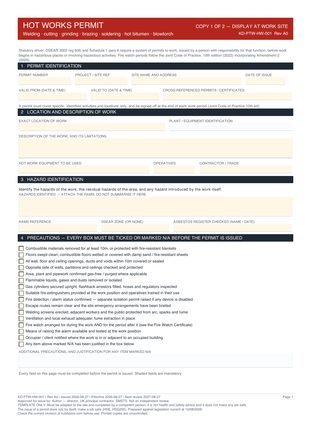
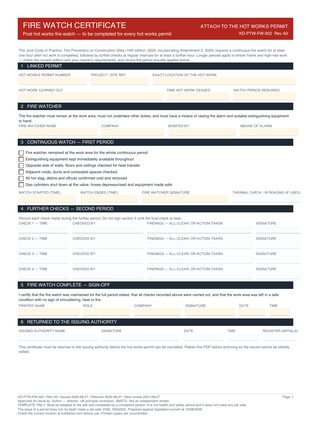
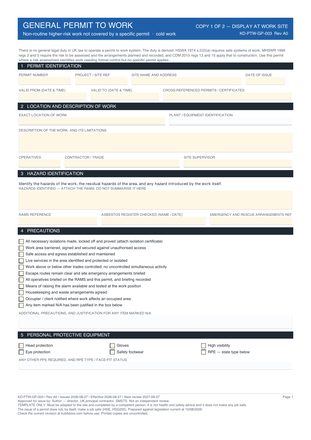
Page one of the first three documents in the bundle. White helmet: usually site managers. Helmet colours vary from site to site; this is a common convention, not a legal standard.
What is in it
33 documents in 5 sections. Open a section, jump to one, or filter across all of them.
Jump to a section · 5
Core permits 9 documents
- KD-PTW-HW-001 Hot Works Permit 3 pages · 83 guided fields
- KD-PTW-FW-002 Fire Watch Certificate 2 pages · 47 guided fields
- KD-PTW-GP-003 General Permit to Work 3 pages · 78 guided fields
- KD-PTW-CS-004 Confined Space Entry Permit 4 pages · 82 guided fields
- KD-PTW-EX-005 Excavation & Permit to Dig 4 pages · 112 guided fields
- KD-PTW-WH-006 Work at Height Permit 4 pages · 83 guided fields
- KD-PTW-RF-007 Roof Work Permit 3 pages · 83 guided fields
- KD-PTW-LO-008 Lifting Operations Permit 3 pages · 78 guided fields
- KD-PTW-PE-009 Permit to Enter 3 pages · 76 guided fields
Electrical safety documents 2 documents
Registers and system documents 7 documents
- KD-SYS-RG-012 Permit Register 2 pages · 200 guided fields
- KD-SYS-AP-013 Permit Application Form 2 pages · 40 guided fields
- KD-SYS-XP-014 Cross-Permit Conflicting Works Check 2 pages · 72 guided fields
- KD-SYS-SU-015 Permit Suspension Record 1 page · 33 guided fields
- KD-SYS-HB-016 Permit Hand-Back Certificate 2 pages · 43 guided fields
- KD-SYS-GT-017 Gas Test & Atmospheric Monitoring Record 2 pages · 130 guided fields
- KD-SYS-SH-018 Permit Shift Handover Record 2 pages · 94 guided fields
Appointments, competence and audit 3 documents
Extended permits 12 documents
- KD-PTW-TL-022 Permit to Load and Strike — Temporary Works 3 pages · 91 guided fields
- KD-PTW-FI-023 Fire Alarm and Detection Isolation Permit 3 pages · 76 guided fields
- KD-PTW-SI-024 Sprinkler and Suppression Impairment Permit 3 pages · 75 guided fields
- KD-PTW-PT-025 Pressure Test Permit 3 pages · 78 guided fields
- KD-PTW-GP-026 Gas Purge and Commissioning Permit 3 pages · 73 guided fields
- KD-PTW-EN-027 Permit to Energise 3 pages · 70 guided fields
- KD-PTW-SC-028 Permit to Cut or Core Structure 3 pages · 70 guided fields
- KD-PTW-MI-029 Mechanical Isolation and Lock-Off Certificate 3 pages · 124 guided fields
- KD-PTW-RA-030 Controlled Area Permit — Ionising Radiation 3 pages · 68 guided fields
- KD-PTW-OH-031 Work Near Overhead Power Lines Permit 3 pages · 71 guided fields
- KD-PTW-LW-032 Live Electrical Working Authorisation 3 pages · 67 guided fields
- KD-PTW-OO-033 Out-of-Hours and Lone Working Authorisation 3 pages · 94 guided fields
How a permit-to-work system fits together
A permit system is not a pile of forms — it is one controlled process with a document at each step. That is why this is sold as a system rather than as twenty-one separate forms: each document below hands off to the next, and every hand-off is recorded.
The life of a permit
| Step | What happens | Document |
|---|---|---|
| 1. Apply | The contractor applies in advance. An application is not a permit and confers no authority to start. | Permit Application Form |
| 2. Check conflicts | The area authority checks what else is live in, above, below or adjacent to the area. HSE's own case study on Piper Alpha identifies the failure as work under one permit affecting work under another, with no cross-referencing between them. | Cross-Permit Conflicting Works Check |
| 3. Isolate | The isolating authority makes and proves the isolations, and issues the certificate. | Electrical Isolation Certificate |
| 4. Test the atmosphere | For confined spaces: instrument, criteria, stratified readings. Entry never begins on a stale test. | Gas Test & Atmospheric Monitoring Record |
| 5. Issue | The issuing authority certifies the precautions are in fact in place, with a specific validity period — never open-ended. | The task permit |
| 6. Authorise | HSE requires the permit to be seen by a second person before it is issued. The issuer and the authoriser must not be the same person. | The task permit |
| 7. Accept | The performing authority accepts the permit and briefs everyone working under it. | The task permit |
| 8. Extend or hand over | Conditions re-checked before any extension; outstanding permits passed formally at shift change. | Permit Shift Handover Record |
| 9. Suspend, if needed | Why, the condition the plant was left in, and the consequences for others — kept at the control point. | Permit Suspension Record |
| 10. Hand back | Work complete, isolations removed and verified, and operational staff acknowledge return of control. | Permit Hand-Back Certificate |
| 11. Cancel | The issuing authority cancels and the register is updated. | Permit Register |
Sitting behind all of it: the Authorised Person Appointment Certificate and Authorisation Scope Matrix record who may sign what and the limits of their authority, and the Permit System Audit Checklist checks the system is being operated as designed.
Which permit do I use?
| The work | The permit |
|---|---|
| Welding, cutting, grinding, brazing, soldering, hot bitumen, blowtorch | Hot Works Permit, plus the Fire Watch Certificate |
| Entry into any confined space | Confined Space Entry Permit, plus the Gas Test Record |
| Breaking ground, or excavation near buried services | Excavation & Permit to Dig |
| A fall risk not already controlled by a handed-over scaffold or MEWP arrangement | Work at Height Permit |
| Access to or work on a roof, or anywhere near a fragile surface | Roof Work Permit |
| A crane, telehandler, gin wheel, tandem or blind lift | Lifting Operations Permit |
| Work on electrical systems made dead, or any electrical isolation | Electrical Permit to Work, plus the Isolation Certificate |
| Contractor access to a live or occupied building | Permit to Enter — the wrapper around any task permit |
| Non-routine higher-risk work that none of the above covers | General Permit to Work |
Operating the system
- Adapt — make each document yours: company details, site specifics, your appointed people.
- Appoint — record in writing who may issue, authorise and accept permits, and the limits of their authority.
- Operate — run the lifecycle above for every permit-controlled job, and keep the register at the permit control point, not in the safety office.
- Keep the records — HSG250 gives a minimum of 30 days on site for a cancelled permit, then archive to your own retention schedule.
The suite ships with its own user manual covering all of this in detail — the legal position, the roles, worked guidance for each document, and every source cited so you can check our working. It is not sold separately.
A permit does not, by itself, make a job safe. It records that someone competent checked the precautions were in place before the work started, and that is a different thing. How the documents work covers what you have to do with any document you buy from us.